Saturday, June 22, 2013

Church (Hagia Sophia)--> Mosque --> Museum (plus The Blue Mosque)

Given the changing political and religious scene in Turkey over the centuries (Constantine's conversion, for instance, led to the creation of beautiful Byzantine churches (Hagia Sophia was one--built in the 6th century).  When the Ottoman Empire took over, many were converted to mosques, which involved plastering over the Christian frescoes and mosaics (this helped preserved many that were later uncovered).  Then Ataturk created modern Turkey, which established the separation of mosque and state--and created a museum.  


 It's hard to get a sense of the size.  Look at the balcony with the columns.  On the second of six openings, under a chandelier, you will see a couple standing at the railing.  The large disks on either size of that balcony are (Ken and I calculated) about 25 feet in diameter.   The building is 170' high--about a 15 story modern building. It's held up by arches on top of arches.

This is the back of one of the "disks"-- Ken (the engineer) was more than a little fascinated by how it was constructed and being held up.  It must weight a LOT, and it's just hanging there!  Note the disk on the opposite wall.  You can get a sense of the size by comparing it to the size of the people in the archway next to it.

 And here's Ken's fingers in a substantial crack in the wall.  The marble floors also undulate.  There have been many serious earthquakes in the nearly 1500 years (!) since it was built.  Yet it still stands!


 This is a view from a window to the courtyard behind the museum.  To the left (we think) is a "flying buttress"--these were added in the last few hundred years to strengthen the building when some problems (such as settling) were noted.  If you'd like to see more, go to www.youtube.com/watch?v=4fsgAwpfJZo
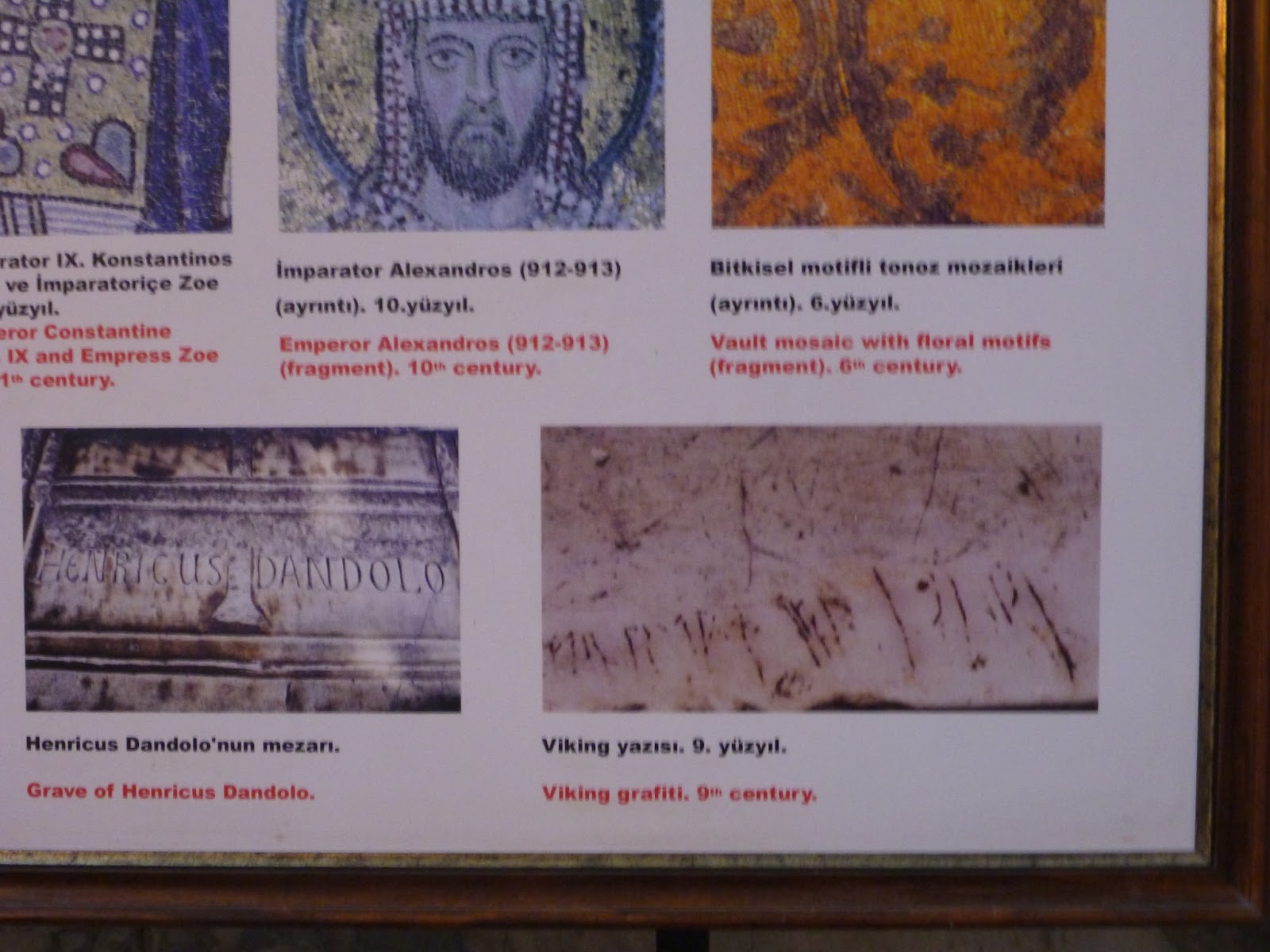
 We looked for the Viking graffiti (9th century!!) pictured in the lower right-hand corner, but didn't find it. 


Mosque exteriors

It's just not possible to get a sense of the grandeur of these buildings from a small photo.  You really hadda be there!


And here's the call to prayer from (I think) the same mosque pictured above.


 I like this photo (above) of the Blue Mosque (six minarets) taken from the ferry across the Bosphorous.  And below, a closer shot (but I'm not sure of which one).


And though the water faucets outside the mosque are supposed to be for washing one's feet and hands before praying, it's also a good place to check email (below).


Mosque interiors

These are self-explanatory, as you can hear Alex describe what we're seeing.  These are two different mosques.  When I get clarification, I'll name them.  One is noted for its stunningly gorgeous blue tile patterns.  The other, larger mosque also has beautiful calligraphy with the "hundred names of God (Allah)" and some prayers.

Protest in Turkey

This is a temporary holding space for videos.....further discussion will follow when we can.

We were in Istanbul about a week after the first demonstrations at Taksim square.  As we walked across the bridge separating the two parts of the city, we unexpectedly encountered a "parade" (i.e. peaceful demonstration) heading toward the park. (The first video.)  We joined them.  The second video is of the mostly young, enthusiastic demonstrators walking toward me.  The three that follow are of posters that were mounted on a glass wall in the square; you'll hear our Turkish friend, Erkut, translating what they say.


And here are the stills of the demonstration the day we happened to be there.  the first photo is of the main street leading to Taksim square.  It is jammed with people and flags on a lovely, sunny afternoon.

 I don't know what the words on the sign below say, but I'll find out.
 And this (below)  is the center of the square....some kind of official memorial to which people had affixed flags and posters.

 Below is the only evidence we saw of the earlier violence that had been reported.  We didn't know who had originally wrecked the vehicle, by judging by the fact that (people told us) it had not been removed for several days, we assumed the official forces left it to show how bad the demonstrators had been.  Clearly, the graffiti was layered on over time.

Sunday, June 2, 2013

Miscellany . .

I came across blogs that I started in Word at various times, but somehow never posted.  So this is a bit of this-and-that . . .

Last night, June 1, I Skyped into the Cohort 13 Orientation--it was morning in California.   The tech folks had figured out a way for me to see the individual students, which was fabulous, since I had not seen most of them face to face, but had worked with them toward admission by phone, email, and Webex.  

I had prepared a few opening remarks that began with, "Kali mera--welcome to sunny Athens!"  More or less at that exact time, it started raining!  Not only that--for the first time in weeks, Ken and I had to wear pajamas to bed.  This is entirely unseasonable weather for Greece on the first of June!!  (To say nothing of the rest of Europe, that has alternately sizzled and frozen during this entire grant period.)  Which reminded me of an earlier post that I had started late in February, but never finished.  

WEATHER OR NOT . . .
 There's been a huge downpour for several hours--thunder, lightening, and about an inch of water on our balcony (the drain can't empty as fast as the rain is coming down).  Now we understand why there is a 3" high marble door-sill between the living-room floor and the balcony.  This isn't the walk-between-the-raindrops we're used to in California--this is taking-a-shower-with-all-your-clothes-on monsoon.  Oh, did I mention the hail?  I think we're getting the tail end of a blizzard that made its way across Europe.

It also knocked out our Internet, which makes for a very disconnected (no pun intended) feeling.  I can live without checking email for a while, but not be able to google?!?!  Hey, Universe, I'm doing some research, here--what's with the being cut off from anything that isn't actually within arms' reach?  I mean, c'mon!  Enough already with the waterworks.   We're good, okay?  Reservoirs full, farms moist, ducks happy.  Besides, today is open-air market in our neighborhood.  Trucks need to drive in from the farms; we need to walk over and replenish our fresh foodstuffs.  So are you done, yet?

[Later in the day, after it had cleared enough for me to meet a colleague for lunch, I learned that these warm monsoon rains began to occur only 5 years ago.  Welcome to climate change, Greece!]


YES, NO, MAYBE . . . ?
Here’s how to say no in most of the languages I can come up with quickly: nein (German), non (French), no (Spanish, Italian).  Here’s Greek (transliterated) ochi.  (Pronounced like the “och” in Loch Lomond, followed by “ee”; accent on first syllable.)

Here's how to say yes in those languages: ya, oui, si.  Here it is in Greek: nai (pronounced in between the sound a horse makes and the "e" in "get").

Listening to Greeks seems to be a whole lot of "no, no, no, no"--except it isn't.  And "ochi" can sound awfully close to "OK." 

Body language just complicates things further. We nod our heads up and down for yes; side-to-side for no.  Greeks do a half-nod down to indicate affirmation and up to indicate denial.   Think of neutral head position as looking straight ahead.  If the chin drops toward the chest, it’s “yes.”  (This can be repeated, which looks reasonably like our own assenting nod.)  But if the chin goes up in the air, it’s “no.”   That, too, can be repeated…leading the unsuspecting to think there is agreement.  

Then there's the high-energy Greek conversational style that means hardly anyone waits until the current speaker has finished before beginning a comment or response. (It's a style I'm very familiar and comfortable with, coming from New York.  Ken, however, is from Iowa--they actually wait a fraction of a second after the current speaker is finished, just in case there is an afterthought.  Of course, that means when all my family is gathered, he hardly gets a word in edgewise.)  

All of which can lead people to the impression that Greeks are confrontational (especially if one cannot understand the actual meanings of the words).  From another perspective, one may say they are enthusiastic, high-affect, ebullient, warm, engaging, upbeat, and so forth.  Only through the generally more "WASP-ish" US (and UK, for that matter) lens might they seem argumentative, rude, loud, obnoxious (all words I have heard applied to folks from the East Coast, so I know those are common interpretations.)  There's obviously a message here in cross-cultural understanding.

Professional Development

I recently presented a workshop on Engaging the Adult Brain for graduate students in the Adult Education department of a Greek university.  It starts with a powerpoint about the implications of current brain research on how adults learn (or don’t). Then the fun begins—participants are given a task to work on in small groups and report their conclusions back to the larger group. 

My hosts warned me more than once that “Greek students are very passive” and were unlikely to participate in the workshop.   I admit to some concern, but it’s not in my DNA to stand there and lecture, so I was willing to take the chance.

As I suspected, after a few moments of discomfort (largely among the youngest of the students, based on the conversations I had as I walked around interacting with groups that were temporarily stuck), nearly everyone got into the task and a couple of groups (my impression again was that those groups had a higher proportion of more experienced, more mature members) really let their imagination and creativity loose.

Their presentations were lively, clever, informative, and engaging—pretty much as I expected.  A colleague who had warned me not to expect much from her students said, slightly abashed, “I could never have believed it.”  So we talked further about this interactive approach.  “But I am a very structured person,” she demurred, “I need to plan in advance what will happen.”   

I did not think to ask at the time, what part of the workshop seemed unstructured!?  I started with a detailed introduction to the content, then described clear and specific directions for the group task (and handed out  a one-sheet synopsis of the major points of the introductory powerpoint).  On reflection, I wondered whether “unstructured” to her meant I don’t know what the students will do or say.  And, perhaps more centrally: will they come away from this experience thinking what I want them to think?

Were I to return to that conversation now, I would ask, “how do you know what they think at the end of your usual lecture?  You know what you told them….but they are not computers recording data.  They are listening and interpreting through their own experiences." (Isn’t that precisely why students get different grades?) And I would also say, “A lot of advance work and planning goes into whatever activity I ask them to do. I structure their small-group experiences with an eye to carefully delineated learning outcomes.

Though I was initially somewhat disheartened to realize that my well-meaning, sincere colleague is teaching the next generation of adult educators (!), she later asked where she could find articles or a course that would tell her how to do some of these “techniques.”  This was an opening for me to suggest that she and I stay in touch (via Skype, for example) about teaching strategies more attuned to adults’ learning needs--which we are planning to do. (And among the first things we're going to examine is whether simply adding to one's "tool kit" is sufficient to become a more effective adult educator.)  I look forward to the opportunity for further professional dialogue--it could be “the camel’s nose under the tent.”  

Saturday, June 1, 2013

Trip to Thessaloniki


This blog entry will be a bit choppy.  This is my first opportunity to blog, though the trip was a couple of weeks ago.  Also on that trip my still camera was not working properly, so most of the documentation is video--not ideal for what are essentially static shots.

We stumbled across the Osios David Monestary by getting lost--one of our talents.   Really.  We delight in finding ourselves where we didn't expect to be.  This tiny (30' x30??) church with a slightly larger courtyard is not the  monastery, itself.  The caretaker told us we could not take photos inside the church, but she kindly explained to us what we saw.  Fortunately, Ken's command of Greek was mostly adequate to the task.   It helped that we knew enough about the life of Christ to fill out the parts where he didn't know the vocabulary.

The church was built  in the 5th century.  That would make it more or less coterminous with Constantine's conversion.  In the 13th century, it was taken over by the Turks (probably not the correct historical term) and turned into a mosque.  Parts of the structure were changed and the religious mosaics and frescoes were plastered over and forgotten.  

This was fortunate from a historical standpoint, because it preserved the ceiling almost intact, and much of the frescoes.  The ceiling was unique, according to our guide, because it depicts the "beardless Jesus"--the only one in the world, she claimed.  The frescoes showed many scenes from the Gospels according to Matthew, Mark, Luke and John in the "flat" style Ken and I have come to associate with Byzantine painting.  After all these centuries, the colors have also faded and there are blank "islands" in the scenes where the fresco could not be saved.  

However, the ceiling over the alter was resplendent in shiny, colorful mosaic.  We didn't have enough Greek to go into details about the restoration process, but it looked to be in very good condition.  It showed Jesus embracing the entire world and sitting on a rainbow.

This is a busy corner in downtown.  In front of a banner strung along a fence is a line of what look like memorial or funeral wreaths.  Ken didn't recognize all the words immediately and we thought we'd figure them out later when we reviewed the video--it wasn't quite clear enough.  Ken's best translation is along these lines (this is a literal, word by word translation, rather than idiomatic):  Nothing treats us with favor or indulgence.  Everything is won with struggles.  Workers everywhere, demonstrate on the street.  May 36  Let's go.  We were puzzled by the date--does it refer to 1936? 

Several of the ribbons on the wreaths identify political or worker organizations.  The ones we could figure out are: Panhellenic Workers' Union, Union of Industrial Employees, and KKE (the Greek Communist Party).
Our final day in the area was spent with a colleague and her husband, who generously invited us on a day-trip to the Halkidiki seashore on the western of the three "fingers" (peninsulas) below Thessaloniki.  On the way we visited the prehistoric caves that had been rediscovered only in the early 20th century.  One of the finds is a 700,000 skull that demonstrates that very early humanoids were here--which expands the narrative of our African origins.  This hillside view doesn't adequately capture of the beauty of this seashore--but I hope you can see how utterly clear the water is!!!!  This is a favorite get-away spot in summer and boasts spectacular beaches and swimming.  We had a fantastic meal--seafood, of course--looking over this gorgeous seaside.

But the knock-your-socks off tourist attraction is the tomb of Philip II--Alexander's father.   In contrast with most Greek ancient sites, which had been discovered and plundered over many centuries, this was successfully hidden until 1977, which meant that its contents were preserved.  In fact, this "museum" actually incorporates the actual tomb!!  (TombS, plural, because two others were also discovered: that of a child assumed to be one of Alexander's siblings, and also of a queen named Cleopatra--not THE Cleopatra--the last of Philip's several wives.)

Because my camera wasn't working well, I couldn't get any fabulous pictures to share.  Just go to the web.  The gold objects in Cleopatra's jewel-box are stunning in their delicacy and beauty.